| |
Dérivées de $f$ autour de $\dot z=0,\alpha _ a=\alpha $ |
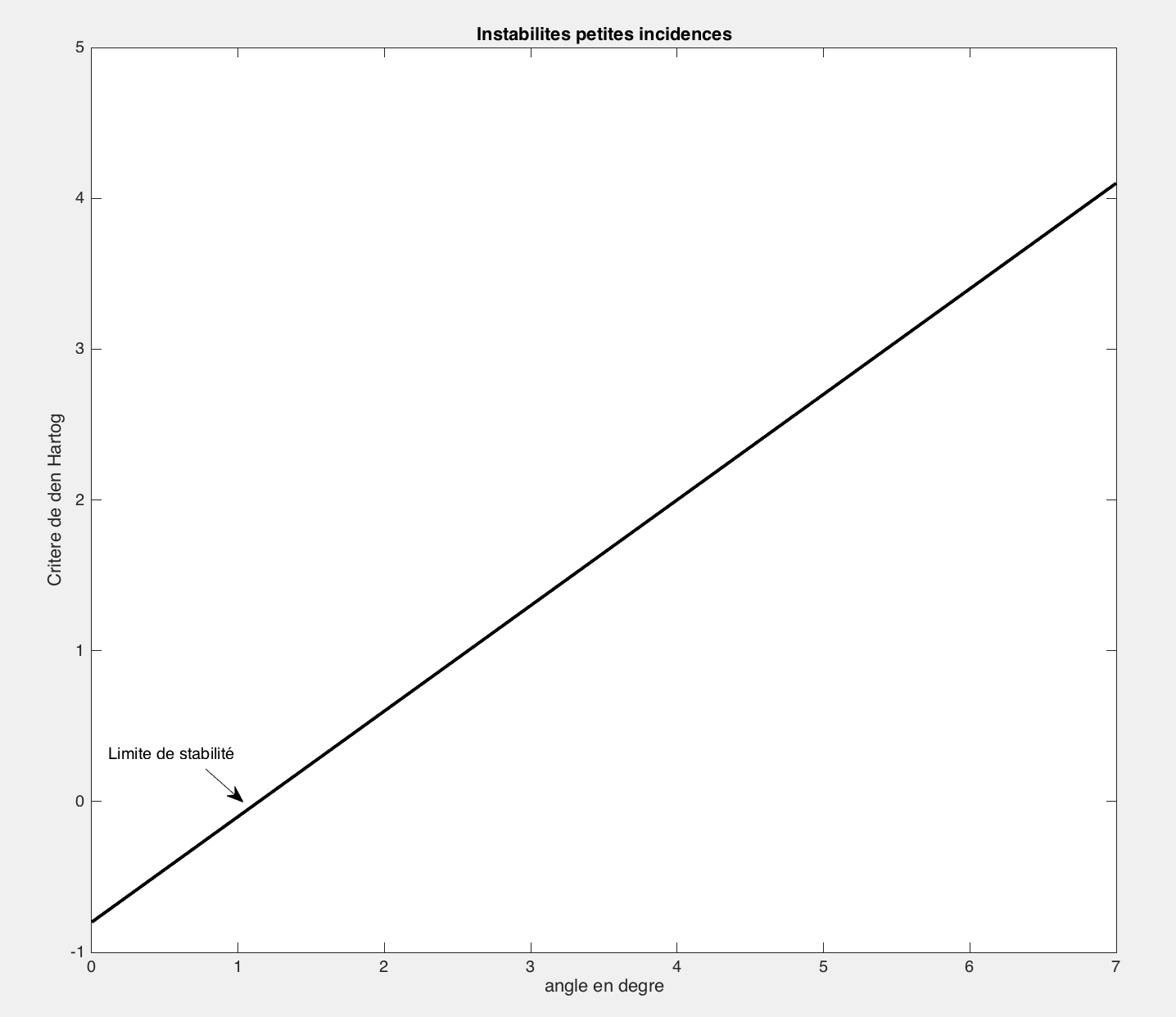
En fait $f$ ne dépend que de $\dot z$, pas de $z$; $\alpha _ a\simeq \alpha -\displaystyle \frac{\dot z}{V},\frac{\partial \alpha _ a}{\partial \dot z}=-\frac{1}{V}, \vert \vert V_ a\vert \vert ^2\simeq V^2$; $-\displaystyle \frac{\partial f}{\partial \dot z}(0,0)\simeq D=\displaystyle \frac{\varrho S V}{2}[c_ x(\alpha )+\hskip-2.84527559055pt\displaystyle \frac{\partial c_ z}{\partial \alpha }(\alpha )]$; $\displaystyle \frac{\partial f}{\partial z}(0,0)= 0$; L’équation linéarisée est: \[ \begin{array}{l}M\ddot z+D\dot z+Kz=f(0,0),\\ z(0)=\dot z(0)=0.\end{array} \] |
|
|
Solutions pour $D{>}0$ |
![\includegraphics[width=3.6cm,height=2.5cm]{aeroimages/image2-3bis.png}](images/img-0015.png) |
|
Solutions pour $D{<}0$ |
![\includegraphics[width=3.6cm,height=2.5cm]{aeroimages/image2-3ters.png}](images/img-0016.png) |
|
|
|


![\includegraphics[width=3.8cm,height=2.5cm]{aeroimages/image2-32.png}](images/img-0017.png)
![\includegraphics[width=3.8cm,height=2.7cm]{aeroimages/image2-30.png}](images/img-0018.png)
![\includegraphics[width=3.8cm,height=2.7cm]{aeroimages/image2-31.png}](images/img-0019.png)